|
Pan American Experiences
|
------- |

Related Articles: |
------------------------------------------412[EXPERIENCE] | |||
Stickball: The Urban Heartbeat of New York’s StreetsBy Jazmin Agudelo for Ruta Pantera on 10/10/2025 10:13:29 AM |
||||
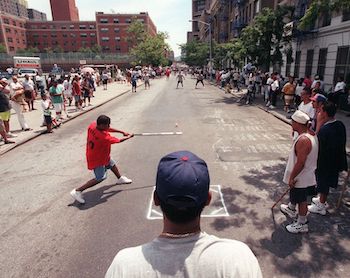
| In the shadow of towering skyscrapers and amid the relentless hum of New York City, a game born of ingenuity and grit thrives in the streets. Stickball, a scrappy, urban cousin of baseball, has long been a cultural touchstone in the city’s working-class neighborhoods. Played with a broomstick, a rubber ball, and an unshakable sense of community, stickball is more than a pastime—it’s a living archive of New York’s history, a testament to the resilience of its people, and a fading yet cherished tradition in an ever-modernizing metropolis. The Origins of Stickball: A Game of Necessity Stickball’s roots are as humble as the neighborhoods that birthed it. Emerging in the early 20th century, the game was a product of necessity, shaped by the constraints of urban life. In the crowded tenements of New York’s immigrant enclaves, children had little access to the sprawling fields required for traditional baseball. Instead, they turned the streets into their diamond, repurposing everyday objects into sporting equipment. A broom handle became a bat, a rubber spaldeen ball—cheap and widely available—served as the pitch, and the urban landscape itself provided the field: manhole covers for bases, parked cars as foul lines, and fire hydrants as outfield markers. The game’s origins are often traced to the 1920s and 1930s, a time when New York was a melting pot of Irish, Italian, Jewish, and Puerto Rican immigrants. These communities, packed into dense neighborhoods, found in stickball a way to forge bonds and assert identity. “Stickball wasn’t just a game; it was a way for kids to claim space in a city that didn’t always make room for them,” says Dr. Maria Torres, a historian of urban culture at City University of New York. “It was about creativity, resilience, and making something out of nothing.” | ||||
| Unlike baseball, which required gloves, cleats, and manicured fields, stickball was accessible to all. Its simplicity allowed it to flourish in places like the Lower East Side, where Jewish and Italian kids played side by side, or in East Harlem, where Puerto Rican youth adapted the game to their own rhythms, incorporating salsa-inflected trash talk and flamboyant playing styles. The game’s rules varied from block to block, but its essence remained constant: hit the ball, run the bases, and outsmart your opponents, all while dodging traffic and navigating the urban maze. The Rules of the Street: How Stickball Is Played Stickball’s beauty lies in its adaptability. There is no single rulebook; each neighborhood crafted its own version, shaped by the quirks of its streets and the personalities of its players. In its most common form, stickball is played with two teams, each taking turns at bat and in the field. The batter, wielding a broomstick or a similar lightweight bat, faces a pitcher who throws a rubber spaldeen ball—small, pink, and bouncy, the iconic “Spalding High-Bounce” ball that became synonymous with the game. The field is the street itself, with bases marked by chalk, manhole covers, or whatever else is at hand. A typical game might designate a fire hydrant as first base, a parked car as second, and a sewer grate as third. Home runs are determined by distance or landmarks—hitting a ball past a certain building or over a rooftop might earn you a homer, while a ball caught in a window frame could be an out, depending on local rules. “Every block had its own constitution,” recalls Eddie Rivera, a 62-year-old Bronx native who played stickball in the 1970s. “On my street, if you hit the ball into Mrs. Rosario’s stoop, you were out. But two blocks over, that was a double.” The game’s pace is fast, with no gloves or protective gear to slow things down. Pitching styles vary: some throw fastballs, others bounce the ball off the pavement for a tricky “stickball curve.” Scoring depends on the number of bases reached, and games often end when the sun sets or a parent calls everyone home for dinner. In competitive settings, like the stickball leagues that emerged in the mid-20th century, games might have set innings or point systems, but in its purest form, stickball is gloriously informal. | ||||
 Add this article to your favorites
[FOR MEMBERS ONLY]
Add this article to your favorites
[FOR MEMBERS ONLY]
Copy this link to send this article to a friend: [FOR MEMBERS ONLY] |
||||
|
|
||||
|---|---|---|---|---|
| |
|
|
|
|
×
|
||||
Please leave a comment about this article: 412 |
|
| Enter your email address: |
Your email will not be displayed. |
| Your nickname: | |
| Your comment: | |
| Was this article helpful to you? | |
|
|
|
Articles about exciting travel experiences in our hemisphere.

ADVENTURE
Cape Froward, Chile


BEACH & SUN

Welcome to the World’s Largest New Year’s Celebration
For those traveling from North, Central, or South America, New Year's Eve in Rio offers a rich narrative about how a city can transform a universal holiday into a unique celebration, rooted in local traditions and open to the world.












|
Experiences Finder
(Search our catalog of Experiences here.) |
|---|