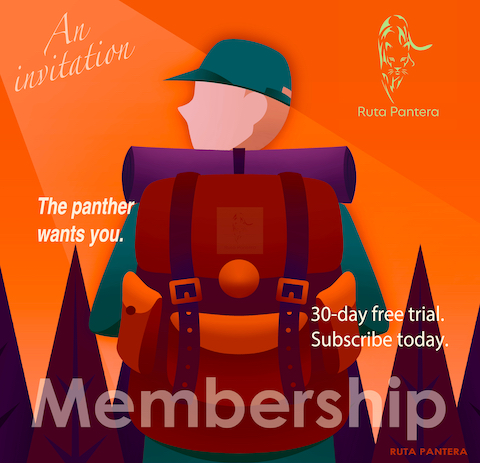
Please consider becoming a member of Ruta Pantera and enjoy unlimited access. Your subscription will be absolutely free for 30 days. After that, subscriptions will be offered for only $8 annually for individual travelers. Thank you so much for visiting Ruta Pantera.
Heydi, Director of Member Services at Ruta Pantera
 |
Become a member of Ruta Pantera
|
------- |


Membership Has Its Benefits
Traveling together brings people closer.

Join Like-minded Travelers
Let the adventure take you away.

Go. See. Transform.
Immersion is the best path and the best part.
Joining Ruta Pantera has benefits for both individual travelers and for people working in the travel industry.
Depending on your choice of membership, our platform can be a digital-age inflight magazine or an essential trade journal, helping to add value to your travel-related business.
Interested in an individual membership? Click on the "Individual Membership" tab above.
For business memberships, click on the
"Business Subscription" tab to learn more.
Annual subscription: $8 for individuals; $15 for businesses. The first 30 days are free, with no commitment.

Endorsements
What our new members are saying about Ruta Pantera.


Ruta Pantera Means Business
Ruta Pantera is fast becoming a valued source of buisness intelligence for professionals working in the travel industry.
As the travel industry changes, Ruta Pantera is here to keep you informed and ready to respond. By joining us, your
business will also be able to connect directly with the Pan American travelers.
Starting with our TravelFAQ, business users can find fast, easy-to-use content that provides immediate answers to common industry questions and insights into new technologies in the industry, visa regulations, trends in corporate travel, and sustainable solutions and initiatives.
A few benefits of business membership
• Free business directory listing
• Unlimited access to our library of articles
• In-depth Business Intelligence reports
• Preferential advertising space
• Access to contact listings
And all for $15 per year with the first 30 days free, with no commitment.
Our TERMS & CONDITIONS agreement is viewable here.

Join Us in Pan America!
It's time for you to join Ruta Pantera, the new gathering spot for Pan American travelers to share experiences, enjoy premier content, and support good causes across the hemisphere.
Why not join us on a life-changing journey in Pan America?
As a member of Ruta Pantera, you'll enjoy 24/7 access to timely travel information, advisories, feature articles, recommendations and personal experiences.
You can share recommendations, connect with other members, and enjoy the RuPa TravelApp.
A few benefits of individual membership
• Daily notification about new destinations
• Unlimited access to our catalog of travel articles
• Entertaining livecasts, style advice, and gear reviews
• English-language training that’s fun and effective
• Access to our TravelApp, for either iPhone or Android
• Convert your Miles Into Smiles in our BioTique shopping area
• Networking with other members who share travel experiences
And all for only $8 per year, with the first 30 days free with no commitment.
Our TERMS & CONDITIONS agreement is viewable here.