|
Pan American Experiences
|
------- |

Brazil Related Articles:
Welcome to the World’s Largest New Year’s Celebration
Favela Verde: An unexpected oasis in Brazil invites you to discover hope
Brazil Pushes Tax Breaks and Regulations To Attract Data Centers
|
BRAZIL ------------------------------------------782[EXPERIENCE] | |||
Discovery of the Brazilian Pumpkin ToadA Tiny Discovery that Illuminates the Richness of the Atlantic Forest and its Conservation ChallengesBy Estefanía Muriel for Ruta Pantera on 12/20/2025 9:12:33 AM |
||||
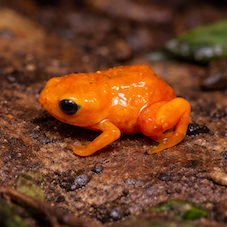
Can a frog smaller than the tip of a pencil redefine our understanding of biodiversity? The answer is yes, and it does so with a bright orange body and a name with political and ecological significance. In the cloud forests of southern Brazil, scientists have identified a new species of gourd toad, Brachycephalus lulai, a creature so tiny it fits in the palm of your hand and so emblematic that it is already inspiring discussions about conservation and environmental policy. The discovery, published in the scientific journal PLOS One, stems from explorations in the Serra do Quiriri, a mountain range covered by cloud forests in the state of Santa Catarina. There, among the damp leaf litter and the silence of the undergrowth, researchers detected unprecedented sounds that led them to this toad, measuring only 8.9 to 13.4 millimeters in length. A Tiny Inhabitant of the Cloudy Mountains The first thing that strikes you about Brachycephalus lulai is its tiny size. Adult males measure between 8.9 and 11.3 mm, while females are slightly larger, reaching up to 13.4 mm, placing it among the smallest known adult tetrapods. Its glossy, bright orange body, speckled with small green or brown spots, contrasts vividly with the dark, damp soil where it lives hidden among decaying leaves and branches. But it wasn’t its color that alerted scientists. It was its peculiar mating calls—“The song consists of two grouped notes, each with between one and four pulses”—that revealed its presence in the dense forest landscape, a crucial method of detection given how well camouflaged it is among the leaf litter. The finding was confirmed through a combination of techniques: DNA analysis, studies of vocalizations, and computed tomography scans to examine bone structure, ensuring that this population represented a distinct species within the diverse genus Brachycephalus. |
||||
|
Small as the tip of a pencil, Brachycephalus lulai symbolizes the immense biodiversity hidden in Brazil’s cloud forests. Image generated with ChatGPT/AI.
The Meaning of Its Name and the Call to Action The scientific epithet “lulai” is not accidental; it pays homage to President Luiz Inácio Lula da Silva. According to the researchers, the name goes beyond taxonomy and serves as a gesture to promote stronger public policies for environmental protection in Brazil, particularly for the Atlantic Forest and its endemic and vulnerable species. “The choice of this name aims to highlight the need to expand conservation initiatives focused on the Atlantic Forest and on Brazil’s highly endemic miniaturized frogs,” the study authors note. Although the habitat of B. lulai remains relatively intact, its area of occupancy is extremely limited, which inherently exposes it to ecological risks. Threats such as grassland burning, livestock grazing, unplanned tourism, mining, and deforestation could further fragment its environment. Biodiversity, Fragility, and Future Research The discovery of Brachycephalus lulai adds another piece to the complex mosaic of Brazilian biodiversity. The Brachycephalidae family currently includes more than 40 species of pumpkin toads, many found exclusively in isolated patches of montane forest in the Atlantic Forest, making them excellent indicators of environmental health and habitat fragmentation. Beyond its scientific value, this discovery underscores a powerful truth: even in well-studied regions, nature can still surprise us. Protecting these microhabitats safeguards not only species as small as B. lulai, but also the intricate ecological networks that sustain life on Earth. |
||||
 Add this article to your favorites
[FOR MEMBERS ONLY]
Add this article to your favorites
[FOR MEMBERS ONLY]
Copy this link to send this article to a friend: [FOR MEMBERS ONLY] |
||||
|
|
||||
|---|---|---|---|---|
| |
|
|
|
|
×
|
||||
Please leave a comment about this article: 782 |
|
| Enter your email address: |
Your email will not be displayed. |
| Your nickname: | |
| Your comment: | |
| Was this article helpful to you? | |
|
|
|
Articles about exciting travel experiences in our hemisphere.

Cape Froward, Chile





Welcome to the World’s Largest New Year’s Celebration
For those traveling from North, Central, or South America, New Year's Eve in Rio offers a rich narrative about how a city can transform a universal holiday into a unique celebration, rooted in local traditions and open to the world.















|
Experiences Finder
(Search our catalog of Experiences here.) |
|---|